



System Change Through Revolution
As a product of the 1960s counterculture I have seen since how clearly it is not possible to change the system from within. It must be destroyed and rebuilt anew. As Mikhail Bakunin famously said, “The urge to destroy is also a creative urge,” seeing destruction not as an end but as a necessary force for revolution, tearing down oppressive structures (like the State) to build something new and free.
I speak as one who has spent decades on the mean streets of Montreal and Vancouver, been a so-called criminal and spent time in prison, done many a bad thing in order to survive. I know full well the underbelly of our society and how the system does not work for you and me but does work for those with money, power and influence. To them the rest of us are but dregs of society, cogs in the wheel of our own misfortune and bad luck.
Therefore this article advocates for deep structural change—economic, political, and social—knowing full well it requires from you confronting an uncomfortable truth: systems do not fundamentally reform themselves. They protect themselves. History shows that entrenched power rarely relinquishes control voluntarily, and meaningful transformation often emerges only when people push beyond the boundaries of what the system allows. And when the system feels threatened they resort to fascism as a means to retain power, as what we are currently seeing in many western countries today, including the most powerful of them all the USA.
The Limits of Reform
Every generation is told the same story: work within the system and change will come. Yet decade after decade, the same inequalities persist. Wealth concentrates upward. Political institutions grow more insulated. Social divisions deepen. The promise of reform becomes a tool of delay rather than progress.
Attempts at incremental change often fail because the system is designed to absorb pressure without altering its foundations. Elections shuffle personalities, not power structures. Policies shift at the margins while the core remains untouched. The result is a cycle of frustration, where people demand justice but receive only symbolic gestures.
Why Revolutionary Change Becomes Necessary
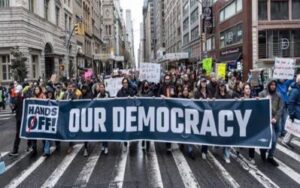
Revolution is not simply an event—it is a recognition that the existing order cannot deliver what people need to live dignified, meaningful lives. When economic systems prioritize profit over people, when political institutions serve elites rather than citizens, and when social structures reinforce inequality, the call for revolution becomes a call for survival.
Revolutionary change does not always mean violence. It means a decisive break from the old order. It means building new institutions, new relationships, and new ways of organizing society that reflect the values of justice, equality, and shared prosperity.
As the writer and activist Grace Lee Boggs argued, revolutions are ultimately about transforming ourselves as much as transforming society. They require imagination, courage, and a willingness to step outside the boundaries of what the system tells us is possible.
Economic Transformation: Beyond Capitalist Constraints
Our current economic model concentrates wealth in the hands of a few while leaving tens of millions struggling. Real change requires:
- Democratic control over major economic institutions
- Redistribution of wealth and resources
- Community ownership of land, housing, and essential services
- A shift from profit-driven priorities to human-centered ones
These changes cannot be achieved through minor policy tweaks. They require a rethinking of ownership, power, and the purpose of the economy itself.
For readers interested in deeper analysis, the Canadian Centre for Policy Alternatives offers extensive research on inequality and structural reform:
Political Renewal: Power to the People
Political systems built on hierarchy and exclusion cannot deliver genuine democracy. A revolutionary approach demands:
- Participatory decision-making
- Decentralized governance
- Transparency and accountability at every level
- The dismantling of corporate influence in politics
These changes challenge the very architecture of the current political order. They require people to reclaim power rather than petition those who hold it.
Social Revolution: Rebuilding Community and Solidarity
Economic and political transformation must be matched by social transformation. A revolutionary society is one where:
- Communities support one another
- Inequality is confronted, not ignored
- Diversity is embraced as strength
- Collective well-being replaces individual competition
This requires cultural change—new narratives, new values, and new forms of solidarity.

The Path Forward
Revolutionary change is not a single moment. It is a process—a long-term commitment to building a better world. It begins with awareness, grows through collective action, and becomes real when people refuse to accept the limits imposed by the existing system.
The future belongs to those willing to imagine it and fight for it. Be a fighter! “In this life, one does not have to stand tall, but one does have to stand up”.
- Waking Life – Self Destructive Man
- How The Economic System is Rigged Against the 99%
- If You Want To Help The World, Focus On Fighting The Empire
❖
Liked it? Take a second to support John Prince on Patreon!